


DETAILS
Salt Harvester
Project
OVERVIEW
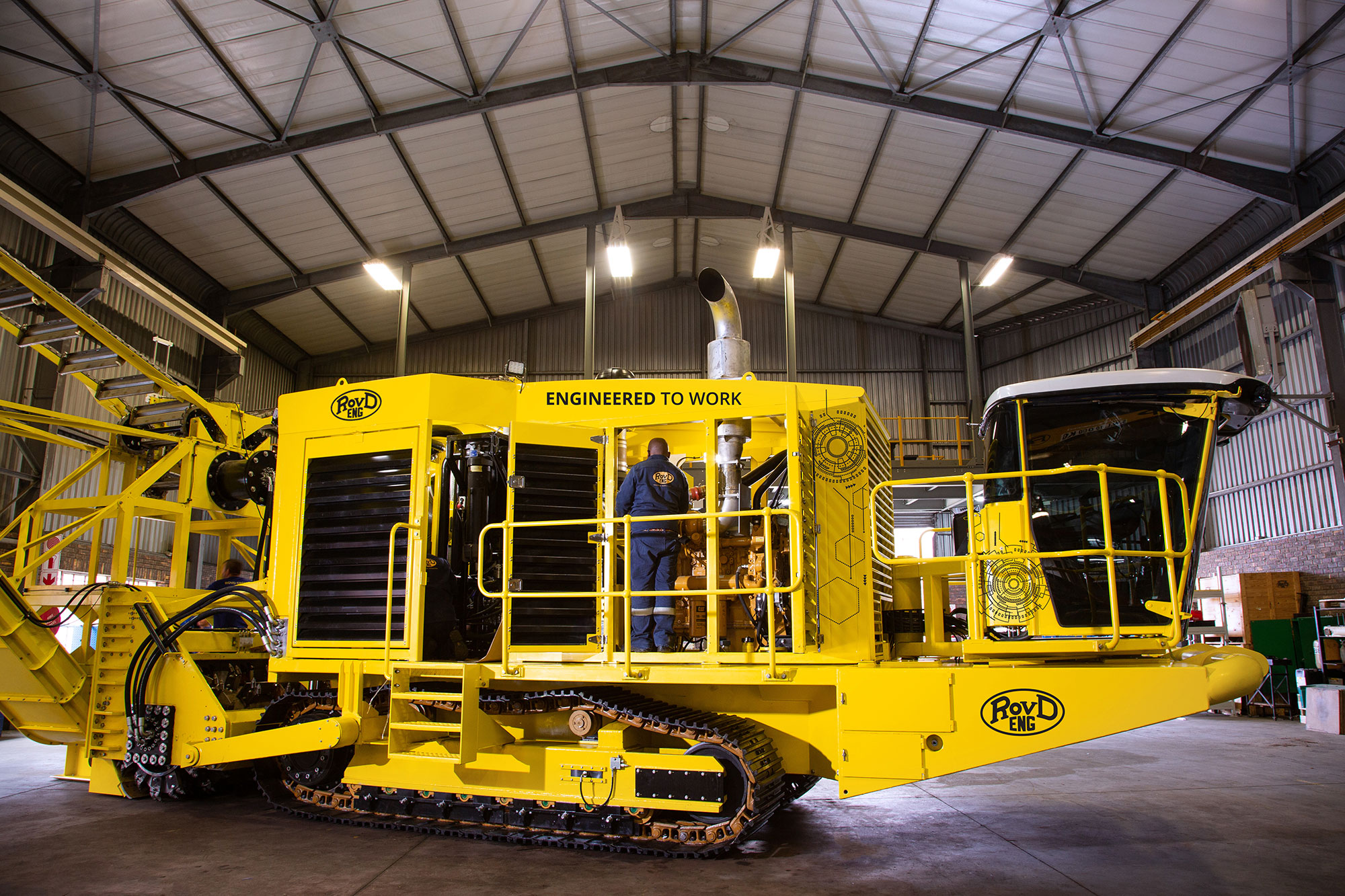
As the world shifts to green energy, a Nelson Mandela Bay engineering firm forges ahead, having designed and manufactured a state-of-the-art salt harvester, ready to be shipped to Botswana. As a result of the tireless efforts and long hours put in by our home-grown team of about 100 ROVD employees, led by Nelson Mandela University (NMU) alumni Heinrich Gerber, the salt harvester can produce 600 tons of unprocessed salt per hour at the maximum elevator discharge rate. This is the first of our new generation salt harvester designs to be produced in the Bay and it is bigger and better than ever.
Gerber, a proud product of Nelson Mandela Bay, completed his schooling at Daniel Pienaar Technical High School in Kariega before obtaining his Mechatronic Degree from NMU. Group MD Garth de Villiers said he was particularly impressed with how Gerber had applied himself to the project due to the complex nature of having to combine electronic engineering, hydraulic engineering, and mechanical engineering.
The salt harvester may resemble the Transformers character, Bumblebee, with its bright yellow coating, but so impressive is the design work by Gerber and his team, it has already caught the European eye. It may have sold around 1,3M USD, but it is probably worth 1,5 – 1,7 million USD at 18:1. Weighing 45 tons and worth ZAR 25 – 30 million, the MODEL DURRANT 718-1215 (600 TPH) is powered by diesel engines that can cope with high altitude and high ambient temperatures typical for salt pans.
ROVD’s business development manager, Athi Lupondwana, said building salt harvesters took a backseat for some time at ROVD, but they were now expecting a boom in the industry as the world shifts its energy requirements to green energy.
This will create an even bigger demand for lithium as it is one of the mineral based salts that are extracted as a by-product of salt mining. Lithium is in high demand as most energy-saving solutions require lithium batteries. We have already received two inquiries this year which substantiate our thinking. The fundamentals of the salt harvester engineering attracted interest from Europe using the base of the salt harvester to be converted into exploration drilling rigs. We expect to have our first design review end of November as the costs for manufacturing these in SA could be significantly cheaper due to the exchange rate.
Lupondwana said they have introduced a telemetry system which is moving the design forward, and as such autonomous harvesting is definitely in our future approach.
ROVD established their reputation as a salt harvester manufacturing concern in the 60’s, but their designs have evolved over the years, and the company has time and again proven to be worth their salt. It is the company’s 23rd salt harvester, designed to Botswana Soda Ash’s specifications, considering factors like permissible ground pressure, crystal structure and properties, and crystal age This information determines the amount of tonnage the salt harvester will produce for the client.
Once ready to be shipped, the harvester will be dismantled into three to four different components for ease of transport. It will then take four to five days by road if all goes smoothly with border control. The performance of the machines in daily production, including metal spraying techniques and carbide tipped cutters, are at the highest level to achieve the desired result.
Some features worth boasting about include:
- Operator cab fully enclosed and tinted to protect against the white glare;
- Air conditioning and LED lighting for 24-hour operation;
- A 3G up-link to maintenance and production personnel; and
- Advanced touch screen control system


GET IN TOUCH
Haven’t found what you’re looking for? Contact us.

- +27 41 453 2530
- 5 Lindsay Rd, Neave Industrial
Eastern Cape, RSA

- +27 41 453 2530
- 5 Lindsay Rd, Neave Industrial
Eastern Cape, RSA

- +27 82 801 0809
- 6 Cubham Street
Eastern Cape, RSA

- +1 864 887 1210
- 560 Brookshire Road
Greer, SC 29651, USA


